Wool Pad Cleaner Spur: Clean, Fluff & Cut Consistently
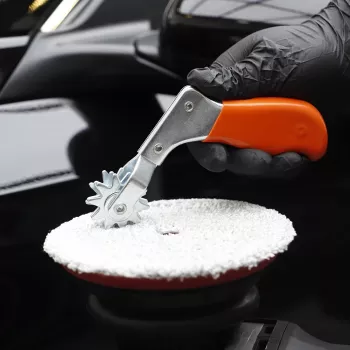
Wool Polishing Pad Cleaner Spur for Revitalizing Polisher Buffing Pads
Wool pads cut fast, but they also load up fast with dried compound, paint residue, and fibers that mat down during use. A pad cleaner spur helps lift and separate the wool while clearing buildup, so the pad runs cooler and finishes more consistently during polishing sessions. When a wool pad stays open and fluffy, it maintains bite without needing extra pressure, which is one of the simplest ways to keep correction predictable from section to section. For more guidance, see TCP Global Polishing Pad Cleaning Spur Tool.
What a pad cleaner spur does for wool buffing pads
A wool pad spur is designed to “reopen” the pad face while you work. Instead of stopping to wash a pad mid-job, you can quickly de-clog the fibers and get back to polishing with a more stable, even-cutting surface. For further reading, see Spta Polisher TCP Global Pad Cleaning Spur Tool.
- Breaks up matted wool fibers so the pad regains loft and bite.
- Removes caked compound and residue that can cause skipping, haze, and extra heat.
- Helps maintain more even rotation on DA and rotary polishers by reducing pad drag.
- Extends pad life by reducing the need for aggressive washing mid-job.
For process guidance on compounding and polishing behavior (heat, pad loading, and consistency), it helps to reference manufacturer training resources such as 3M Automotive Refinishing and education hubs like RUPES.
Signs a wool pad needs spurring
Pad performance typically drops before the pad looks “dirty” from a distance. Catching loading early prevents overheating and keeps the finish more uniform.
- Pad face looks glossy or flattened instead of fluffy and open.
- Increased dusting and clumping of compound on the pad.
- Polisher feels like it’s hopping, bogging, or requiring more pressure to keep working.
- Finish quality drops (more micro-marring or uneven correction) even with the same polish and technique.
How to use a wool pad spur (quick workflow)
The goal is light, even cleaning—think “combing and lifting,” not grinding. A few seconds at the right time is usually more effective than aggressive spurring after the pad is fully caked.
- Turn the polisher on at a low-to-medium speed and hold it securely so the pad face is accessible and stable.
- Lightly place the spur against the spinning wool face; use minimal pressure and let the tool do the work.
- Move across the pad in short passes to lift fibers evenly rather than digging into one spot.
- Stop periodically to inspect the pad: look for restored loft and reduced caking before resuming polishing.
- For heavy buildup, spur first, then blow out with compressed air (if available), then resume with a primed pad and a controlled amount of product.
Spurring checklist by situation
| Situation | What to do | When to stop |
|---|---|---|
| Light loading (early in the set) | 1–2 quick passes across the face | Wool looks separated and fluffy |
| Heavy caking (dry compound/paint residue) | Multiple light passes + inspect between passes | No hard crust remains; fibers aren’t clumped |
| Pad feels grabby or runs hot | Spur briefly, then reduce product amount and clean more often | Pad spins freely with less drag |
Safety and best practices
- Keep hands, cords, and loose clothing clear of the spinning pad and spur.
- Use light pressure to avoid gouging the pad or stressing the backing and adhesive.
- Avoid spurring at very high speeds; controlled speed reduces the chance of grabbing or tearing fibers.
- Do not use on foam pads unless the spur is explicitly designed for foam (most spurs are intended for wool).
- If the pad shows torn backing, loose hook-and-loop, or severe shedding, retire it instead of forcing more use.
Pad makers often publish care guidance that aligns with these basics; see references like Lake Country Manufacturing for general pad-care principles and product notes.
When to spur vs. when to wash a wool pad
Spurring and washing solve different problems. Spurring is a fast “mid-polish reset,” while washing is the deep clean that removes oils and embedded residue.
- Spur during the job to keep cutting consistent and reduce heat buildup between sections.
- Wash after the job (or when the pad remains gummy or saturated) to remove oils and embedded residue that spurring can’t fully clear.
- If a pad stays matted immediately after spurring, it may be over-saturated with product; switch pads and clean the loaded one thoroughly.
- Using multiple pads in rotation often produces better, steadier results than trying to push one pad for the entire job.
A practical rhythm for many correction sessions is: light spur between sections, swap to a fresh pad when you feel drag returning quickly, then wash everything thoroughly at the end.
Compatibility and typical use cases
Quick fit-and-use guide
| Tool | Best matched pad type | Goal |
|---|---|---|
| Pad cleaner spur | Wool pads | Lift fibers and remove caked residue mid-polish |
| Pad brush | Foam or wool (tool-dependent) | Light surface cleaning and dust removal |
| Pad wash + rinse | All pad types | Deep clean after use or when saturated |
Care, storage, and getting longer life from wool pads
Shop tools in stock
- Wool Polishing Pad Cleaner Spur for Revitalizing Polisher Buffing Pads
- Clarks Men’s Black Leather Slip-On Shoes
FAQ
Can a pad spur be used while the polisher is spinning?
Yes. It’s typically used on a slowly spinning pad with light pressure, keeping the tool stable and hands clear so the wool can be lifted and de-caked evenly.
Will spurring a wool pad damage it?
Not when done lightly and with short, even passes. Damage usually comes from high speed, excessive pressure, or staying in one spot long enough to tear fibers or stress the backing.
How often should a wool pad be spurred during polishing?
Spur as soon as you see matting or feel performance drop—often every section or panel on heavy correction work. Rotating between multiple pads helps keep results steadier and reduces overheating.







Leave a comment